
Aji Charapita
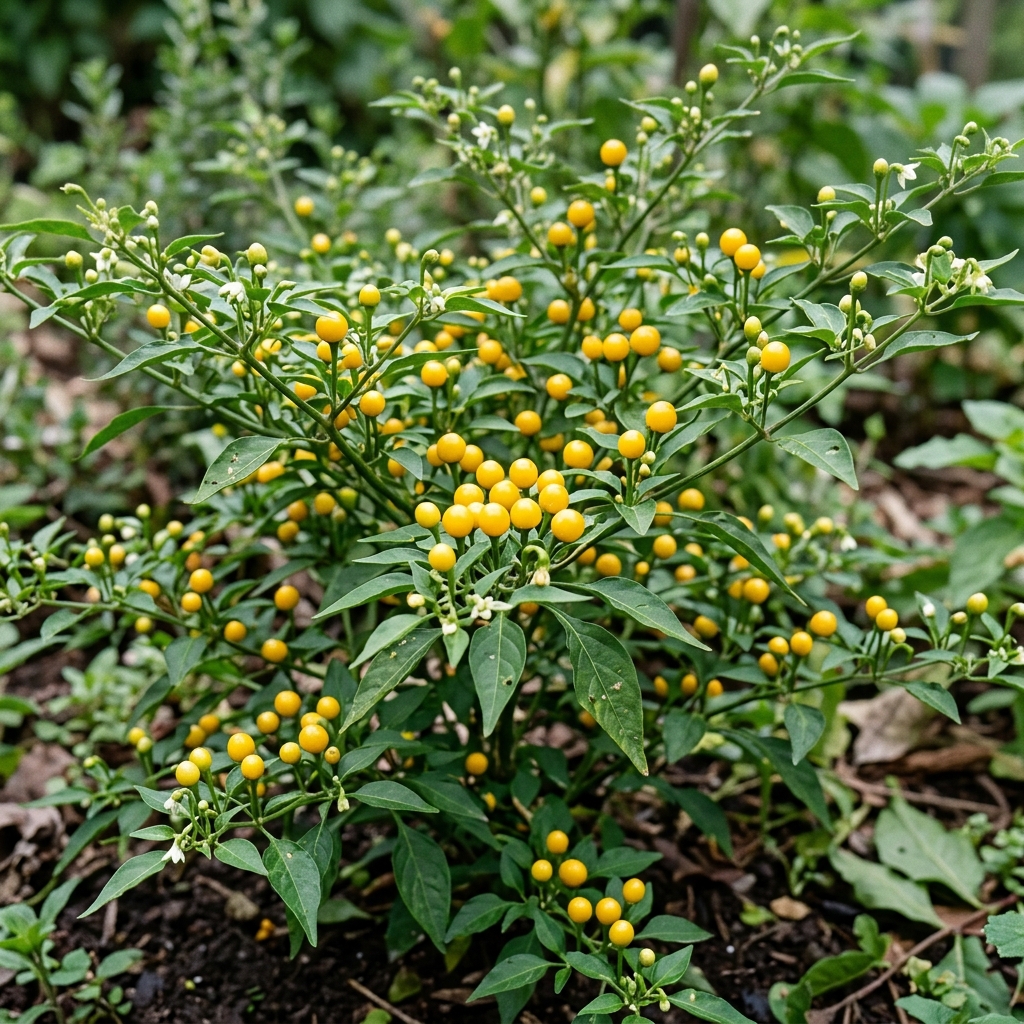
Aji Charapita is a wild landrace pepper belonging to the species Capsicum chinense, native to the Loreto and Ucayali regions of the Peruvian Amazon basin. The plant produces dense flushes of tiny, pea-sized spherical berries that transition from green to a vivid bright yellow at full maturity. Delivering a sharp, quick burst of heat rated between 30,000 and 50,000 Scoville Heat Units, this open-pollinated variety has gained global renown as an exceptionally aromatic chili.
Distinguished by its erect fruit orientation and intensely fruity, tropical aroma, Aji Charapita combines high ornamental appeal with versatile culinary utility. The bushy plants yield hundreds of thin-walled pods across the growing season. Frequently cited as one of the world’s most expensive commercial spices, its combination of punchy pungency, citrusy flavor, and miniature berry morphology makes it a unique staple of Amazonian gastronomy.
Origin and Genetics
Aji Charapita is an open-pollinated wild landrace originating in the Amazon basin of Peru, primarily within the Loreto and Ucayali regions. Classified taxonomically as Capsicum chinense, it represents an ancestral, stable form of the species that thrives naturally in tropical rainforest conditions. It is commonly distinguished from other wild C. chinense types, such as Cumari, by its specific Peruvian Amazonian provenance, distinctly spherical berry shape, and bright yellow mature coloration. While the yellow form is canonical, a red-fruited phenotype also exists in cultivation as Aji Charapita Red.
Botanical Profile
The plant grows as a dense, branching, bushy shrub with green foliage and small, thin leaves. Its solitary or clustered flowers are white with faint greenish-yellow tones. The fruits are miniature, spherical, pea-sized berries with smooth surfaces and thin interior walls. Unlike many cultivated chinense varieties whose fruits hang downward, Aji Charapita pods display an erect orientation, held upright above and throughout the leaf canopy as they transition from immature green to bright yellow.
Heat Profile
Aji Charapita is classified as a medium-hot pepper, with laboratory measurements typically spanning 30,000 to 50,000 SHU on the Scoville scale. The heat is characterized by a sharp, quick onset that registers primarily on the tongue and the front of the palate, delivering an immediate burst of pungency without the lingering, deep-throat burn associated with larger habanero-type cultivars.
Flavor and Aroma
Despite its small physical dimensions, the fruit possesses an exceptionally concentrated sensory profile. It exhibits a pungent, floral, and tropical aroma that releases immediately upon piercing the thin skin. On the palate, the flavor is markedly fruity and citrusy, providing a bright, clean taste that balances its rapid pungency before the heat subsides.
Cultivation
As a native of the Amazon basin, Aji Charapita thrives in warm climates with full sun and high humidity. It is a prolific producer, developing a canopy loaded with hundreds of small fruits across a single season. The dense contrast of bright yellow berries against green foliage gives the shrub significant ornamental value alongside its agricultural utility.
Culinary Applications
In Amazonian and international cuisine, Aji Charapita is utilized both fresh and preserved. Its thin walls make it ideally suited for whole drying and powdering, while its high moisture and aromatic volatile content lend themselves well to fresh salsas, hot sauces, and seasoning pastes. Whole pods are also frequently used to create infused finishing oils and specialty vinegar infusions, or preserved by pickling and freezing.



Leave A Comment