

Trinidad Moruga Scorpion
The Trinidad Moruga Scorpion is a super-hot landrace cultivar of Capsicum chinense indigenous to the Moruga district of Trinidad and Tobago. The variety gained widespread international recognition following 2012 scientific evaluations conducted by the New Mexico State University Chile Pepper Institute, which documented a mean pungency exceeding 1.2 million Scoville Heat Units (SHU) and an individual peak fruit reaching 2,009,231 SHU.
Distinguished from standard scorpion types by its rounded, golf-ball-like shape and heavily pitted, rugose skin, the Trinidad Moruga Scorpion frequently lacks a pronounced stinger tail, featuring instead a short or recessed tip. Beneath its intense, deeply persistent burn lies a sweet, floral, and fruity profile, making it a foundational landrace for ultra-hot hot sauces, powders, and capsaicinoid extract production.
Origin and Genetics
The Trinidad Moruga Scorpion developed as an open-pollinated landrace in the southern coastal district of Moruga, Trinidad and Tobago. Belonging to the species Capsicum chinense, the cultivar gained institutional documentation in 2012 when the New Mexico State University Chile Pepper Institute analyzed replicate plots of super-hot cultivars to evaluate capsaicinoid concentration and yield stability.
Botanical Profile
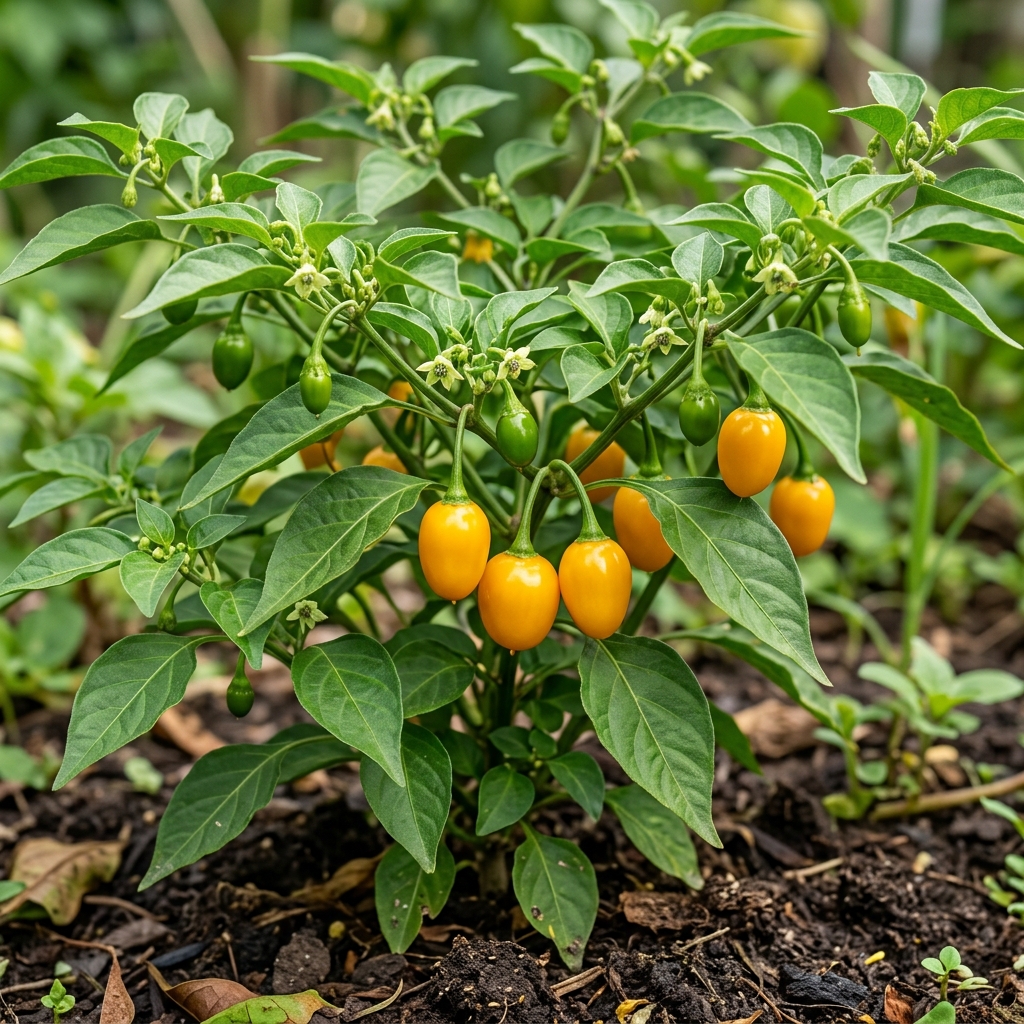
Plants produce greenish-white flowers that develop into pendant, turbinate to roughly spherical fruits resembling textured golf balls. The pod surface is heavily rugose, bumpy, and pitted, differing noticeably from the smoother skin of conventional scorpion varieties. Pods transition during ripening from green to orange-red and ultimately to a vivid, deep red at full maturity, often terminating in a blunt, slightly pointed, or recessed base rather than a long, pronounced tail.
Heat Profile
Classified firmly in the super-hot (1,000,000+ SHU) bracket, the Trinidad Moruga Scorpion exhibits an intense, building, and deeply persistent burn. In the 2012 New Mexico State University Chile Pepper Institute trials, the cultivar registered an overall mean heat level of 1,207,764 SHU across harvested plots, with a singular high-testing pod reaching 2,009,231 SHU—the first recorded instance of an individual pepper surpassing the two-million threshold in formal scientific literature.
Flavor and Aroma
Before the severe heat engages, the pods deliver pronounced sweet, fruity, and floral flavors. The aroma is similarly aromatic, carrying pungent, floral, and fruit-forward notes typical of high-capsaicinoid Caribbean Capsicum chinense cultivars.
Cultivation
Growing the Trinidad Moruga Scorpion requires warm conditions characteristic of its tropical origin. Plants thrive best in full sun and require well-draining soil along with sustained warm ambient temperatures to support floral set and the prolonged development period necessary for super-hot pod maturation.
Culinary Applications
Due to its extreme capsaicin concentration, the Trinidad Moruga Scorpion is primarily handled with protective equipment and used sparingly in specialized food production. It serves as a core ingredient in ultra-hot hot sauces, concentrated chili powders, and industrial extract production. Common preservation methods include drying, fermentation, and freezing to retain pungency and flavor over extended storage.



Leave A Comment