
Banana Pepper
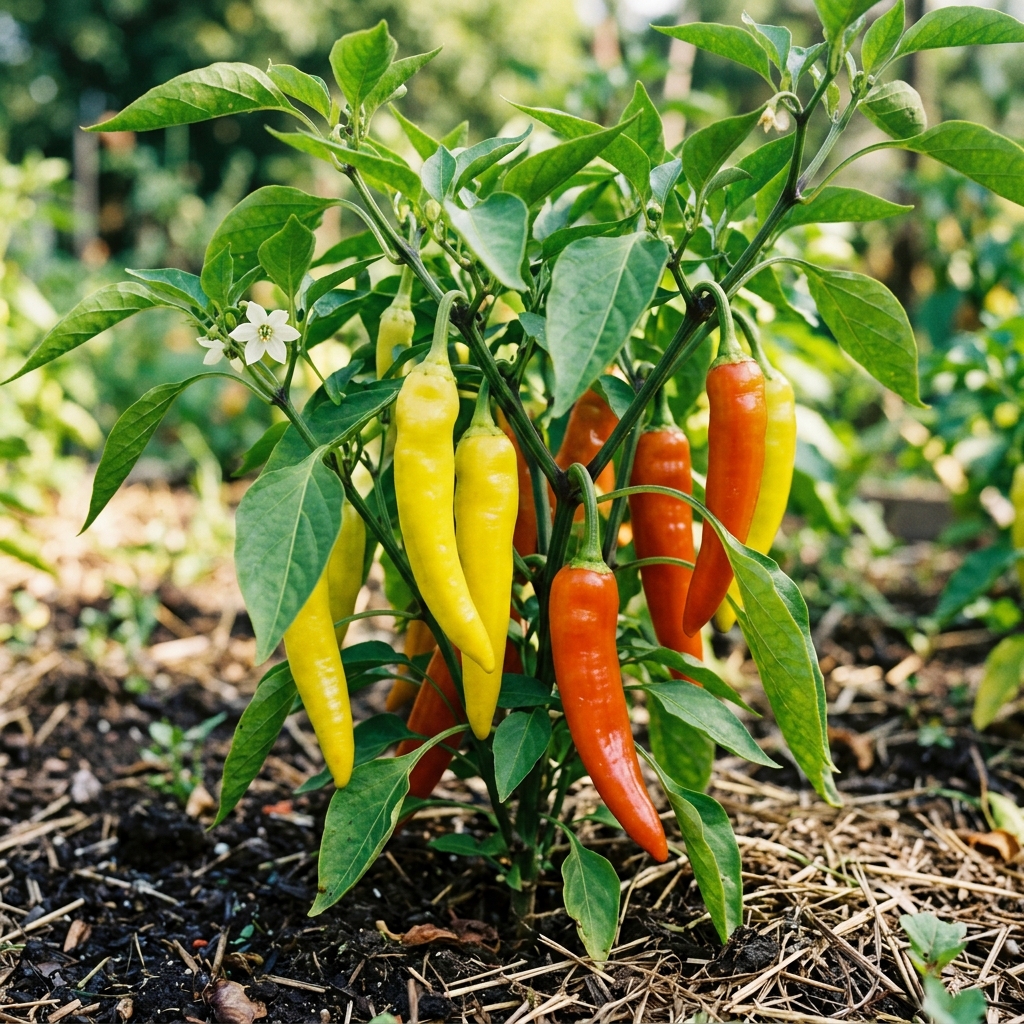
The banana pepper, also known as the yellow wax pepper or banana chili, is a mild cultivar of Capsicum annuum renowned for its elongated, slightly curved shape. Rating between 0 and 500 SHU on the Scoville scale, this cultivar produces smooth, pendant pods that shift from pale green to a signature bright yellow before fully ripening to orange and red.
Primarily harvested during its immature yellow wax phase, the fruit is prized for its crisp, tangy, and sweet culinary qualities. Although visually similar to the significantly hotter Hungarian Wax pepper, the banana pepper is distinguished by its minimal capsaicin content, offering subtle tang on the palate without lingering pungency.
Botanical Profile
The banana pepper develops on an upright bushy plant characterized by standard green foliage and solitary white flowers. Its pendant fruits are elongated and tapering, frequently exhibiting a gentle curve reminiscent of a banana. The pod surface is smooth and slightly lobed with a medium wall thickness.
During development, the pods undergo a distinct color transition, emerging pale green before shifting into a vibrant, waxy yellow. If left to mature fully on the plant, the pods progress through orange to a deep red, with the bright yellow immature stage offering moderate ornamental value against the plant’s green canopy.
Heat Profile
Classified strictly as a mild chili pepper, the banana pepper registers between 0 and 500 Scoville Heat Units (SHU). Its low capsaicin concentration produces a subtle, tangy sensation concentrated across the tongue and palate, carrying little to no lingering heat.
Due to its shared yellow wax phenotype, the banana pepper is frequently confused with the Hungarian Wax pepper. However, Hungarian Wax is notably hotter, typically ranging from 5,000 to 10,000 SHU, whereas the true banana pepper remains exceptionally mild.
Flavor and Aroma
The culinary appeal of the banana pepper centers on its crisp texture and sweet, tangy flavor. Its aroma is mild, clean, and characteristic of fresh garden vegetables with faint grassy undertones. While pods are conventionally eaten in their tangy yellow stage, fully mature red pods develop an enhanced natural sweetness.
Cultivation
Banana peppers require standard warm-season cultural practices, thriving in full sun and fertile, well-draining soil with consistent moisture. Due to its compact and upright growth habit, the cultivar performs well in both container gardening and greenhouse settings.
Culinary Applications
Thanks to its medium wall thickness and mild profile, the banana pepper is widely utilized in both fresh and preserved preparations. It is a classic choice for pickling and canning, frequently sliced into rings as a topping for pizzas, sandwiches, and salads. Whole pods are also suitable for mild stuffing applications.



Leave A Comment