
Choricero Pepper
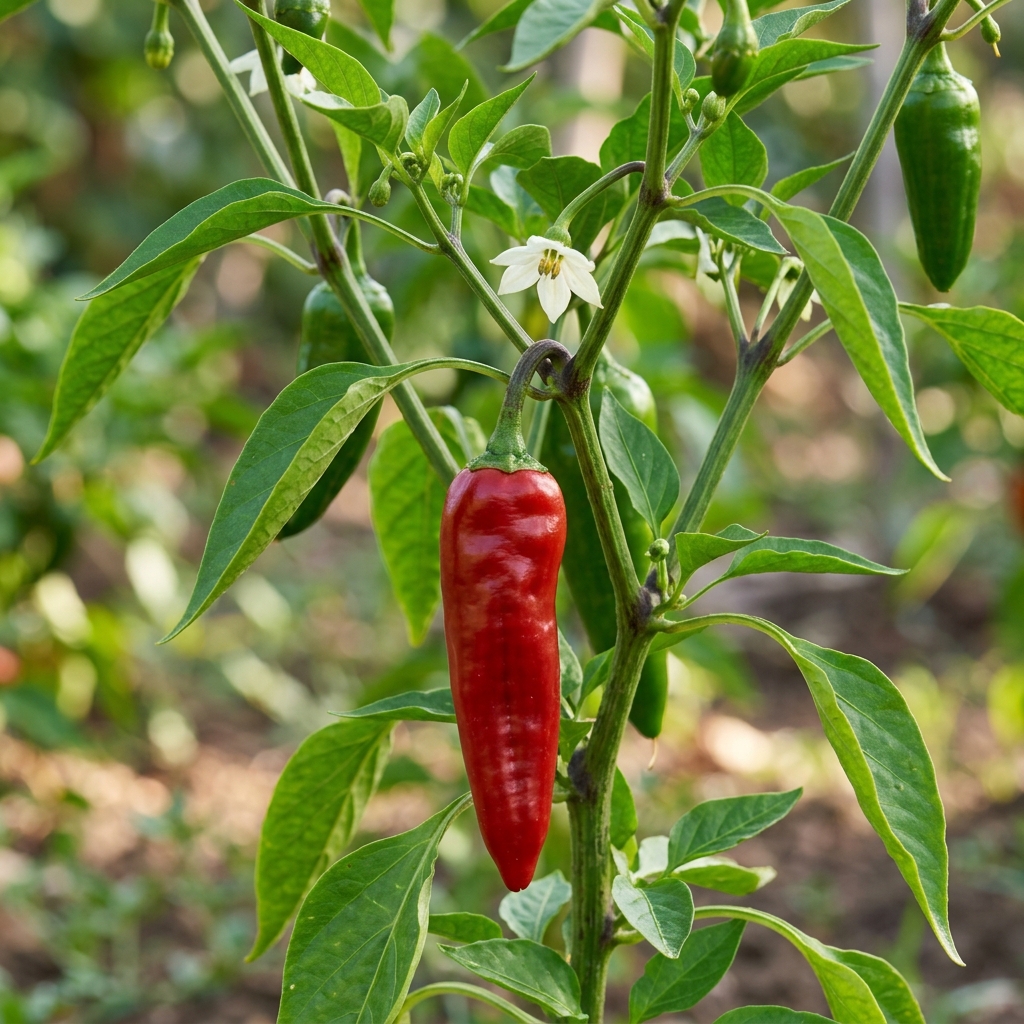
The Choricero pepper is a traditional Spanish heirloom belonging to the Capsicum annuum species, originating from the Basque Country in Northern Spain. Grown as a stable open-pollinated landrace, this mild pepper registers between 0 and 1,000 SHU on the Scoville scale, presenting negligible capsaicin pungency. The plant produces elongated, conical pods with medium wall thickness that hang in a pendant orientation, transitioning from green to deep red as they ripen.
Renowned for its essential role in northern Spanish gastronomy, the variety develops a pronounced sweet and earthy pulp with subtle fruity undertones. Rather than being eaten as a fresh table pepper, Choricero pods are traditionally harvested mature and strung into ristras for air-drying, where the skin deepens to a dark burgundy-brown. The concentrated dried pulp provides a foundational flavoring and coloring agent for traditional sausages and regional stews.
Origin and Genetics
The Choricero pepper is an established heirloom landrace deeply rooted in the agricultural traditions of the Basque Country and broader Northern Spain. Identified botanically as Capsicum annuum, it maintains an open-pollinated, stable genetic line sustained across generations of regional selection. The cultivar is closely associated with traditional rural preservation practices, where whole harvests are dried on farmhouse facades to supply year-round culinary needs.
Botanical Profile
The plant exhibits an upright, branching shrub growth habit characterized by standard green foliage and solitary white flowers. Pods develop in a pendant orientation, suspended downward from the branches. Morphologically, the fruits are elongated and conical with a slightly ribbed, undulating surface texture and medium wall thickness. As the peppers mature, their color shifts from green to a rich, deep red. The internal placenta bears pale yellow to cream-colored seeds.
In dried pepper classification, the Choricero is often discussed alongside the Spanish Ñora; however, they remain morphologically distinct. While the Ñora produces small, round, squat fruits, the Choricero is distinctly conical and elongated.
Heat Profile
Evaluating between 0 and 1,000 SHU, the Choricero sits at the lowest end of the Scoville scale. It is classified as a mild pepper with negligible capsaicin burn. The variety is cultivated entirely for its dense, aromatic flesh and sugar content rather than for pungency.
Flavor and Aroma
Fresh Choricero peppers offer a mild, fruity sweetness. When dehydrated, the flavor profile concentrates substantially, yielding prominent earthy, sweet, and slightly smoky notes accompanied by a rich, fruity aroma. The pulp retains high solubility and depth, making it well suited for long-simmered culinary bases.
Cultivation
Choricero peppers thrive in warm climates and require full sun exposure paired with well-draining soil. Due to their medium flesh thickness and favorable flesh-to-water ratio, the pods respond exceptionally well to standard dehydration methods, resisting rot when cured in dry, well-ventilated environments.
Culinary Applications
The primary value of the Choricero pepper lies in its preserved form. Whole mature pods are air-dried in decorative hanging arrangements known as ristras, dehydrated mechanically, or processed into jarred pulp, referred to as carne de pimiento choricero.
To use dried pods, cooks rehydrate them in warm water and scrape the softened pulp from the inner skin. This pulp serves as the foundational flavoring component for classic Basque preparations, including Marmitako, Bacalao a la Vizcaína, and authentic salsa vizcaína. Additionally, the concentrated pulp is an essential curing and seasoning ingredient in traditional Spanish chorizo production.



Leave A Comment