
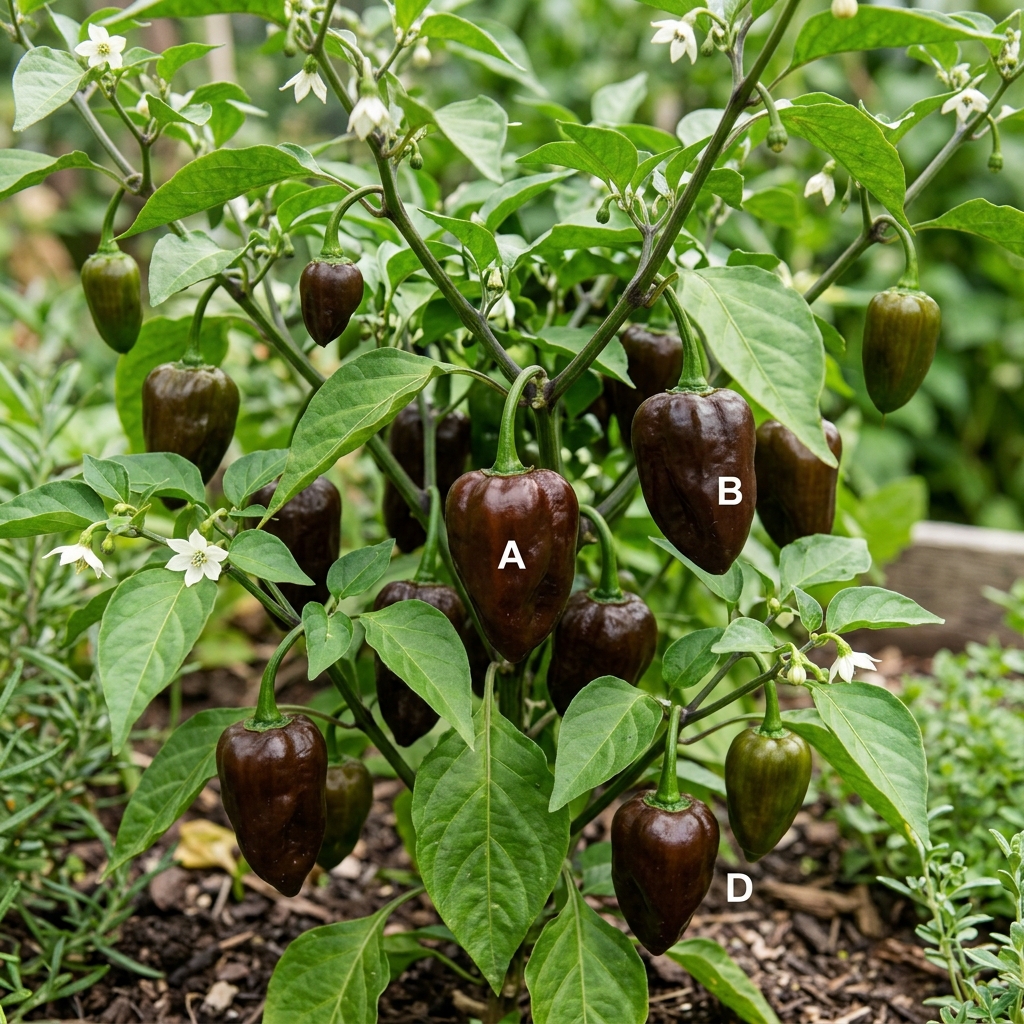
Mulato Pepper
The Mulato pepper is an open-pollinated landrace cultivar of Capsicum annuum originating from the Puebla region of Central Mexico. Closely related to the standard Poblano, it produces pendant, broad conical to heart-shaped fruit that delivers a gentle, warming heat typically ranging between 1,000 and 2,500 Scoville Heat Units.
What distinctly characterizes the Mulato is a specific chlorophyll-retention gene that causes the pods to mature into a deep chocolate brown rather than ripening red. Highly prized as an indispensable element of the traditional Mexican holy trinity of mole chiles, the dried fruit provides deep aromatic complexity marked by notes of licorice, dried cherry, and smoke.
Origin and Genetics
The Mulato pepper is a traditional, open-pollinated landrace originating from Puebla in Central Mexico. Botanically classified under Capsicum annuum, it shares close genetic lineage with the Poblano chile. While standard Poblanos transition from green to red upon full maturity, the Mulato carries a distinctive chlorophyll-retention trait where persistent green pigments blend with red carotenoids, creating a rich chocolate-brown coloration directly on the plant.
Due to similarities in shape, Mulato is frequently confused with Ancho and Pasilla peppers. However, Ancho chilies are fully ripe red Poblanos that turn reddish-brown when dried, whereas Mulato ripens brown on the vine. Pasilla chilies originate from the Chilaca pepper, which displays a much narrower, elongated pod shape.
Botanical Profile
The plant grows as an upright, branching shrub with standard green foliage and solitary white flowers. Its fruit grows in a pendant orientation, displaying a broad conical, heart-shaped silhouette that tapers toward the blossom end. The pods have a medium wall thickness and feature a surface that ranges from smooth to slightly undulating or wrinkled. Immature pods start dark green before transitioning fully into a deep, dark brown.
Heat Profile
Mulato is categorized as a mild chili pepper, registering between 1,000 and 2,500 SHU on the Scoville scale. The pungency delivers a slow, gentle warmth concentrated primarily on the tongue and the back of the throat, providing warmth without overpowering adjacent flavors.
Flavor and Aroma
The sensory profile of the Mulato pepper is defined by rich, layered complexity. Both fresh and dried pods exhibit sweet, earthy, and fruity aromas. On the palate, the chile combines earthy and smoky qualities with pronounced hints of licorice, dried cherry, and unsweetened chocolate, which intensify significantly when the fruit is dried.
Cultivation
Adapted to warm climates, Mulato plants require full sun and well-drained soil to thrive. The stable, open-pollinated cultivar develops a sturdy shrub structure and offers moderate ornamental value in garden beds due to the contrasting dark green foliage and rich chocolate-toned fruit.
Culinary Applications
Mulato is famous as a core ingredient in traditional Mexican mole poblano and other complex sauces, including enchilada bases, stews, and savory marinades. The medium walls also make fresh or rehydrated pods suitable for stuffing. Beyond fresh use, the cultivar is widely preserved through sun drying, dehydration, and grinding into chile powders to preserve its dried-fruit flavor profile for long-term culinary use.



Leave A Comment