
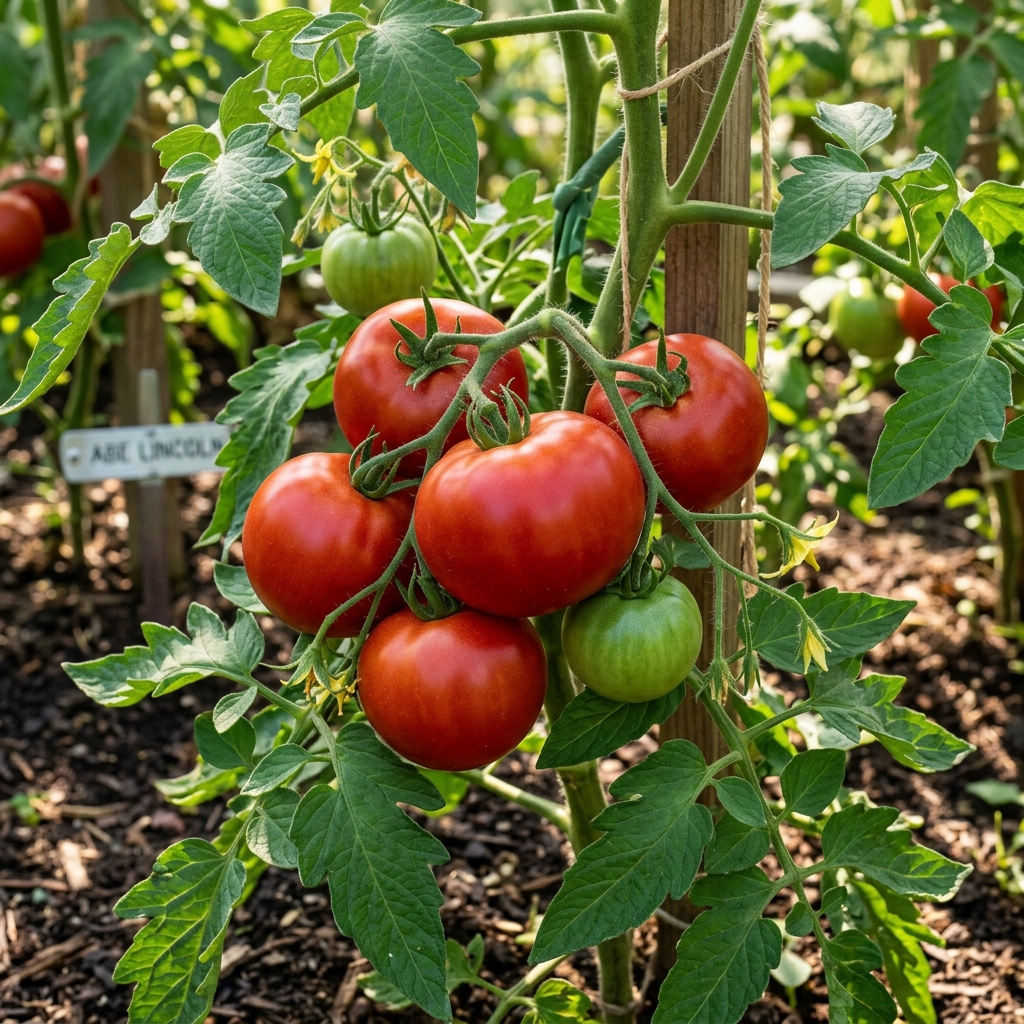
Abe Lincoln
The Abe Lincoln tomato (Solanum lycopersicum), also widely distributed as Abraham Lincoln, is a historic American heirloom introduced in 1923 by the W. H. Buckbee Seed Company of Rockford, Illinois. Developing as a vigorous indeterminate vine with standard green regular foliage and yellow blossoms, the variety produces heavy clusters of round, uniform fruit suited for outdoor field production.
This classic cultivar is recognized for its medium to large red slicer fruit, which features smooth exterior skin and dense, meaty red flesh. Renowned for its balanced ratio of sweetness to acidity, Abe Lincoln remains a culinary staple for fresh table use, salads, and canning, while its open-pollinated genetic stability allows growers to save true-to-type seed across seasons.
Origin and Genetics
The Abe Lincoln tomato was released commercially in 1923 by the W. H. Buckbee Seed Company, an established seed firm located in Rockford, Illinois. Marketed interchangeably under the names Abraham Lincoln and Abe Lincoln, the variety quickly became a signature midwestern heirloom. As a stable open-pollinated cultivar, it maintains its core varietal traits when grown with appropriate spatial isolation to prevent cross-pollination. Over the decades following its original release, multiple commercial selections have entered distribution while preserving the line’s defining physical characteristics.
Botanical Profile
The plant exhibits an indeterminate vining habit characterized by continuous vegetative growth and ongoing floral development throughout the active season. Its foliage consists of standard green regular leaves that support clusters of bright yellow flowers. Immature fruits develop as uniform green globes before transitioning to a uniform, deep red exterior across the surface and shoulders.
Morphologically, the fruits are classified as medium to large round slicers. They are notable for their smooth, unribbed skin and structural firmness. Internally, the flesh is solid, meaty, and saturated red, providing substantial bulk suitable for clean slicing.
Flavor and Culinary Applications
Abe Lincoln delivers a classic tomato flavor defined by well-proportioned acid and sweet notes. This balanced sensory profile prevents the fruit from tasting overly sharp or excessively sugary, aligning with traditional expectations for mid-century American slicers.
Due to its high flesh density and moderate seed volume, the cultivar is widely utilized for fresh slicing, sandwiches, and mixed salads. The structural integrity and balanced acidity of the meaty flesh also make it well-suited for home canning and preservation.
Cultivation
As an indeterminate variety that produces heavy fruit clusters, Abe Lincoln requires full sun exposure and ample structural support in field settings. Standard trellising, staking, or caging is necessary to support the long vining stems and keep developing fruit off the ground. For seed preservation, standard isolation distances for heirloom tomatoes should be maintained to ensure varietal purity.



Leave A Comment