
Cheongyang Chili Pepper
The Cheongyang chili pepper (Capsicum annuum) is a spicy Korean cultivar developed by Dr. Yoo Il-woong at Chungang Seed Co. and commercialized in 1983. Created by crossing a native landrace from Jeju Island with a pungent Thai chili pepper, this cultivar serves as South Korea’s benchmark spicy pepper, registering between 4,000 and 12,000 Scoville Heat Units.
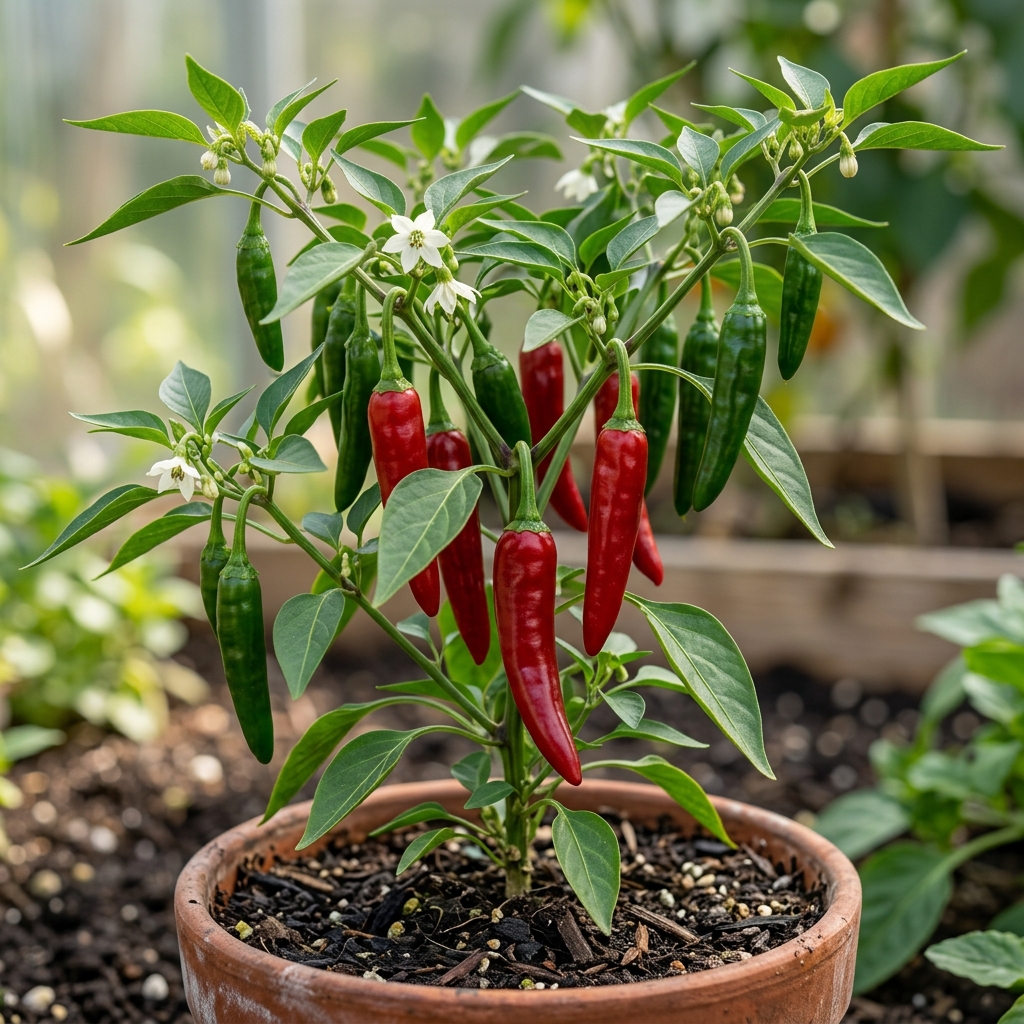
Characterized by an erect, branching growth habit and slender, glossy pendant pods that transition from deep green to bright red, the pepper delivers a distinctively sharp, piercing heat localized on the tongue and throat. Distinct from non-pungent Korean culinary varieties like Put-gochu, the Cheongyang pepper is widely utilized across both its immature green and mature red stages to impart clean pungency to traditional soups, stews, and side dishes.
Origin and Genetics
Commercialized in South Korea in 1983 by Chungang Seed Co., the Cheongyang chili pepper was developed by Dr. Yoo Il-woong. The breeding lineage combines a local landrace from Jeju Island with a pungent Thai pepper. The cultivar’s name was coined by combining characters representing Cheongyang and Yeongyang counties, where extensive agricultural trials took place. Produced as an F1 hybrid, seeds collected from mature fruits do not breed true to type and will segregate in subsequent generations.
Botanical Profile
The plant grows as an erect, branching subshrub featuring green foliage and white flowers. Its fruits develop in a pendant orientation, forming smooth, glossy pods with an elongated, conical shape that is often slightly curved. Immature pods emerge in deep green before ripening fully into a vivid crimson red.
Heat Profile
With an intensity ranging from 4,000 to 12,000 SHU, the Cheongyang chili pepper is significantly hotter than standard Korean gochu cultivars. It is defined by an immediate, piercing heat profile that acts cleanly across the tongue and throat without lingering heavily.
Flavor and Aroma
Alongside its upfront pungency, the pod possesses a crisp bite accompanied by a mild, subtle sweetness. The aroma is fresh and green, complementing its sharp flavor profile in both unripe green and fully ripe red harvesting stages.
Cultivation
Cheongyang peppers require full sun, well-drained soil, and warm temperate to subtropical conditions. Because the cultivar is maintained as an F1 hybrid rather than an open-pollinated line, commercial growers rely on standardized hybrid seed stock to maintain consistent heat levels, pod morphology, and plant vigor.
Culinary Applications
A staple across Korean cuisine, Cheongyang peppers are used fresh, sliced raw for seasoning sauces, or incorporated into side dishes (banchan) and pickled preserves (jangajji). They are widely added to simmering soups and stews, such as jjigae and guk, to introduce clear, bright heat. The pods are also frequently preserved by drying or freezing for year-round culinary use.



Leave A Comment