
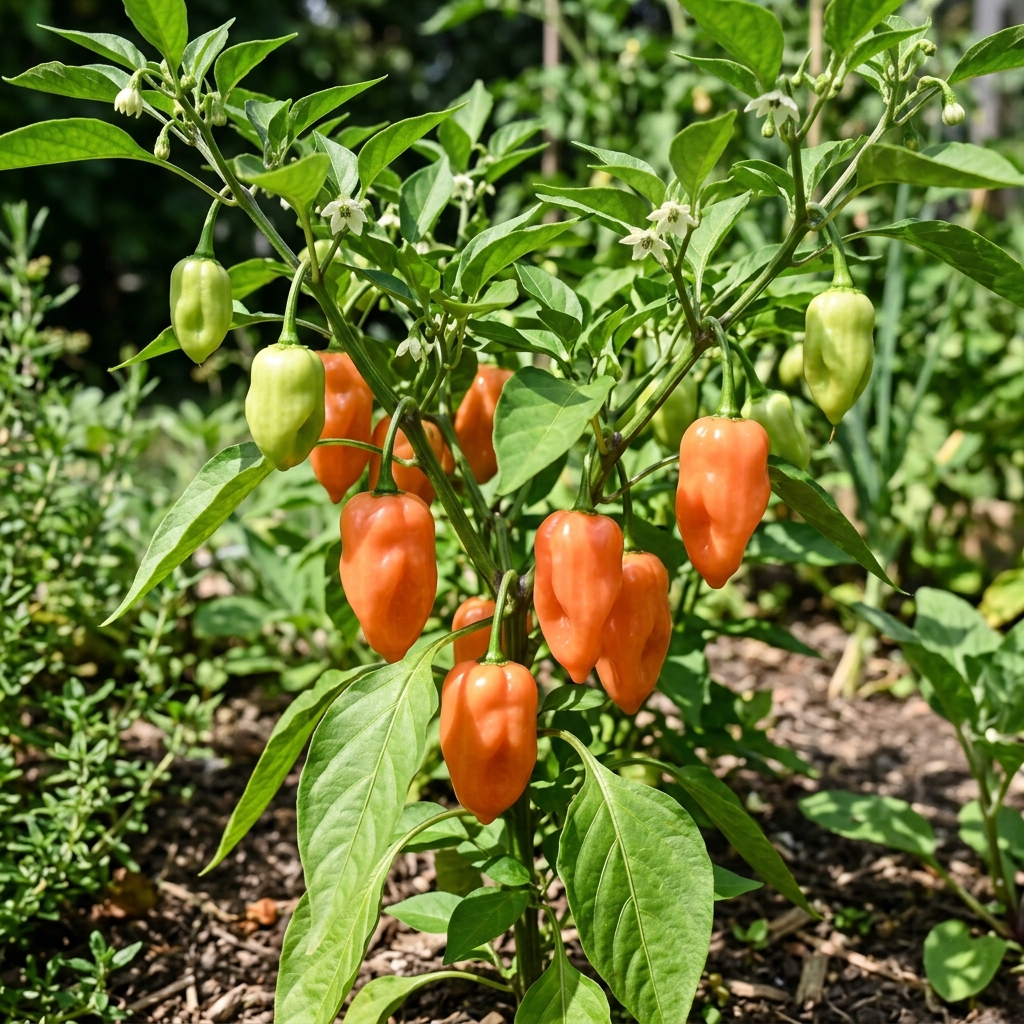
Habanada Pepper
The Habanada pepper is an open-pollinated Capsicum chinense cultivar bred by plant breeder Dr. Michael Mazourek at Cornell University in Ithaca, New York. Introduced in 2014, the variety was selected from an unreleased non-pungent mutation discovered within university breeding lines, creating a stable habanero-type pepper that completely lacks capsaicinoid heat.
Rated at 0 SHU, Habanada provides the complex floral, melon, and tropical fruit aromatics typical of habanero varieties without any burning sensation. The compact plants produce pendant, lobed pods that transition from pale green to a characteristic salmon-orange at maturity, making it a standout cultivar for culinary applications requiring pure fruit aroma.
Origin and Genetics
The Habanada pepper originated in Ithaca, New York, developed through breeding programs led by Dr. Michael Mazourek at Cornell University. Selected from a naturally occurring, unreleased heatless mutation, the cultivar was stabilized as an open-pollinated variety and introduced in 2014. It represents a targeted effort to decouple the rich flavor compounds of Capsicum chinense from the high capsaicin concentrations normally present in the species.
Botanical Profile
Habanada exhibits a bushy, compact growth habit with standard green foliage and white flowers tinted with green. The pendant pods display classic C. chinense morphology, featuring a lobed, slightly elongated, and tapered habanero shape with smooth to undulating, ribbed surfaces and medium-thin walls. During development, the immature fruit transitions from pale green to a luminous, bright salmon-orange when fully ripe, housing cream-colored seeds.
Heat Profile
Habanada is entirely sweet and non-pungent, measuring 0 SHU across all testing metrics. Because it produces no capsaicinoids, it presents zero onset, throat catch, or lingering heat, allowing uninhibited consumption of the pod’s underlying flesh and placental tissue.
Flavor and Aroma
The primary appeal of Habanada lies in its authentic habanero aromatic profile. It delivers pronounced floral and tropical fruit aromas paired with sweet, melon-like, and fruity flavors. Without the masking effect of intense heat, the nuanced organic flavor compounds inherent to chinense peppers remain directly accessible on the palate.
Cultivation
As a warm-season crop, Habanada thrives in full sun and well-draining soil. Its compact stature makes it well-suited for container gardening as well as standard greenhouse and field cultivation. Because Habanada is an open-pollinated cultivar, growers wishing to save true-to-type seed must isolate plants from pungent Capsicum chinense accessions to prevent insect-mediated cross-pollination that could reintroduce heat into subsequent generations.
Culinary Applications
Habanada is versatile in the kitchen, particularly for preparations where authentic habanero flavor is desirable without capsaicin intensity. It is frequently sliced raw into salads, blended into fresh salsas, or cooked into sweet, fruit-forward sauces and marinades. The pods also perform well when preserved through pickling, freezing, or dehydrating, and their natural sweetness lends itself effectively to confectionery applications.



Leave A Comment