

Indigo Rose
Indigo Rose is an open-pollinated saladette tomato (Solanum lycopersicum) bred by Dr. Jim Myers at Oregon State University in Corvallis, Oregon, and released in 2011. Classified as an indeterminate cultivar with regular foliage and yellow flowers, it produces small, smooth, round fruits that represent a milestone in conventional breeding as the first commercially released high-anthocyanin purple tomato line from the OSU program.
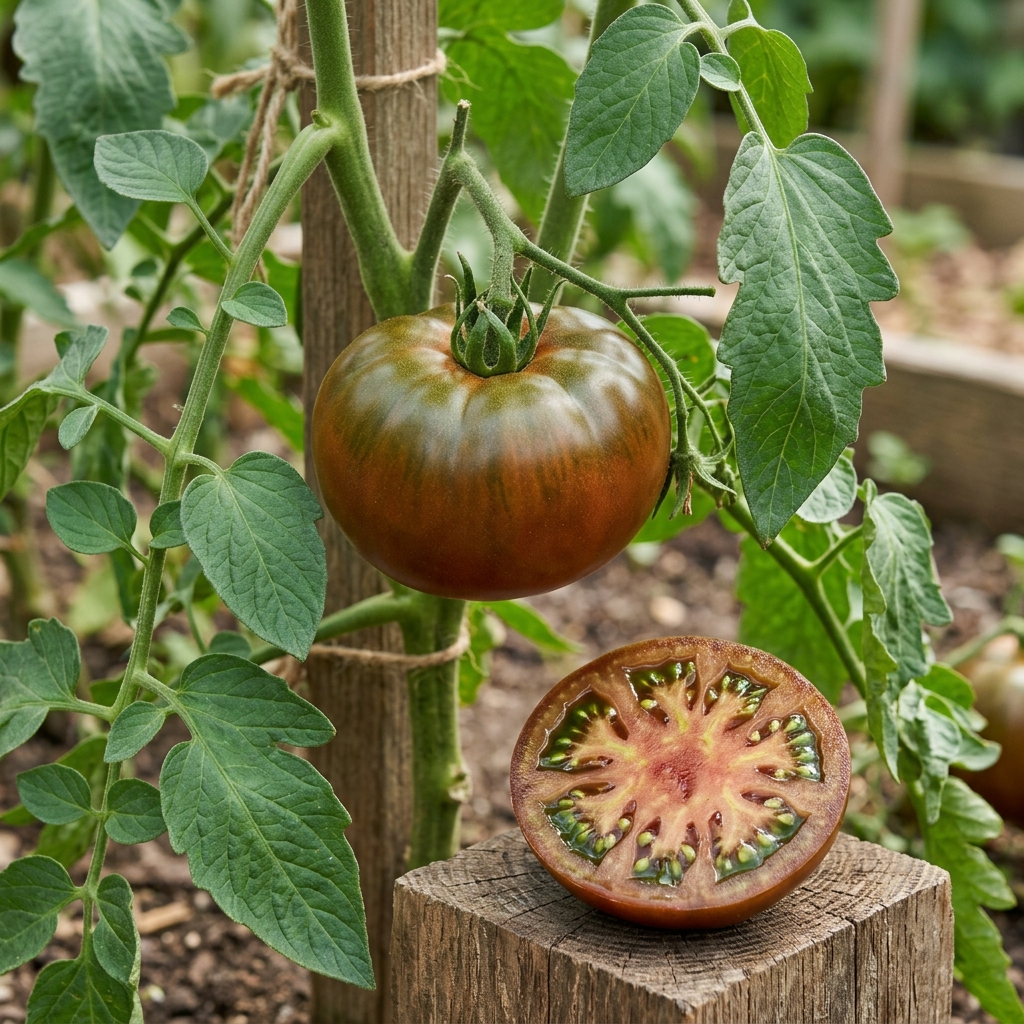
The cultivar is characterized by dramatic sun-dependent pigmentation driven by introgressed wild tomato genetics. Where exposed to direct ultraviolet light, the fruit surface synthesizes dense concentrations of anthocyanin pigments, turning deep blue-purple to black over a contrasting red flesh interior, while shaded areas ripen to a dull reddish-brown. This stable modern cultivar is well suited for fresh eating, slicing, and salads.
Origin and Genetics
Indigo Rose was developed in Corvallis, Oregon, by Dr. Jim Myers at Oregon State University and officially released in 2011. Rather than utilizing genetic modification, breeders developed the line through conventional breeding methods, introgressing wild tomato germplasm into standard cultivated stock. Its distinctive coloration traces to the Aft (Anthocyanin fruit) gene sourced from Solanum chilense alongside the atv (atroviolaceum) gene derived from Solanum cheesmaniae. The resulting cultivar is genetically stable and open-pollinated.
Botanical Profile
The plant exhibits an indeterminate growth habit with standard regular-leaf foliage and yellow flowers. Its smooth, round saladette fruits fall into the small size class. The standout botanical feature is its light-dependent pigmentation: immature fruits display green and purple tones, maturing to a striking combination of dark purple-black on sun-exposed skin and red within the interior flesh. Because anthocyanin synthesis requires direct exposure to ultraviolet light, unexposed undersides and shaded surfaces transition from green to a dull reddish-brown, leaving the fruit interior red.
Cultivation
Because anthocyanin expression depends entirely on direct ultraviolet exposure, Indigo Rose requires full sun conditions to achieve its characteristic deep purple to black coloration. It is well suited for outdoor field production. As a stable, open-pollinated cultivar, growers can save seeds from mature fruits with the assurance that subsequent generations will breed true, provided the plants are isolated from cross-pollination with other tomato varieties.
Culinary Applications
With its small saladette size, round shape, and dramatic visual contrast between the dark skin and red interior flesh, Indigo Rose is primarily utilized for fresh eating, slicing, and salads. In addition to its culinary role, the high-contrast coloration gives the cultivar notable ornamental value in garden plantings.



Leave A Comment