
Manganji Pepper
Manganji pepper is a celebrated Japanese sweet chili belonging to the species Capsicum annuum, originating in the Manganji area of Maizuru within Kyoto Prefecture. Developed during the Taisho era as an open-pollinated cross between the traditional Kyoto heirloom Fushimi togarashi and an introduced Western bell pepper, it is completely non-pungent and registers at 0 Scoville Heat Units.
Regarded as the ‘king of Japanese chili peppers’ and formally registered under Japan’s Geographical Indication system as Manganji Amato, the cultivar is prized for its thick, succulent flesh and exceptionally tender skin. Its long, gently creased pods carry very few seeds, which remain concentrated near the calyx, delivering a sweet, crisp vegetal bite without the bitterness or heat of standard chili varieties.
Origin and Genetics
Manganji pepper originated in the Manganji area of Maizuru City in Kyoto Prefecture, Japan, during the Taisho era in the early 1920s. Local farmers developed the cultivar from an intentional or spontaneous cross between the slender heirloom Fushimi togarashi and an introduced Western bell pepper of the California Wonder type. This lineage combined the elongated shape of traditional Japanese chilis with the thick, fleshy walls of sweet bell peppers.
The variety is recognized as a traditional Kyo-yasai (Kyoto vegetable) and holds official protection under the Japanese Geographical Indication (GI) Act under the name Manganji Amato. It remains a stable, open-pollinated cultivar maintained through selective local cultivation.
Botanical Profile
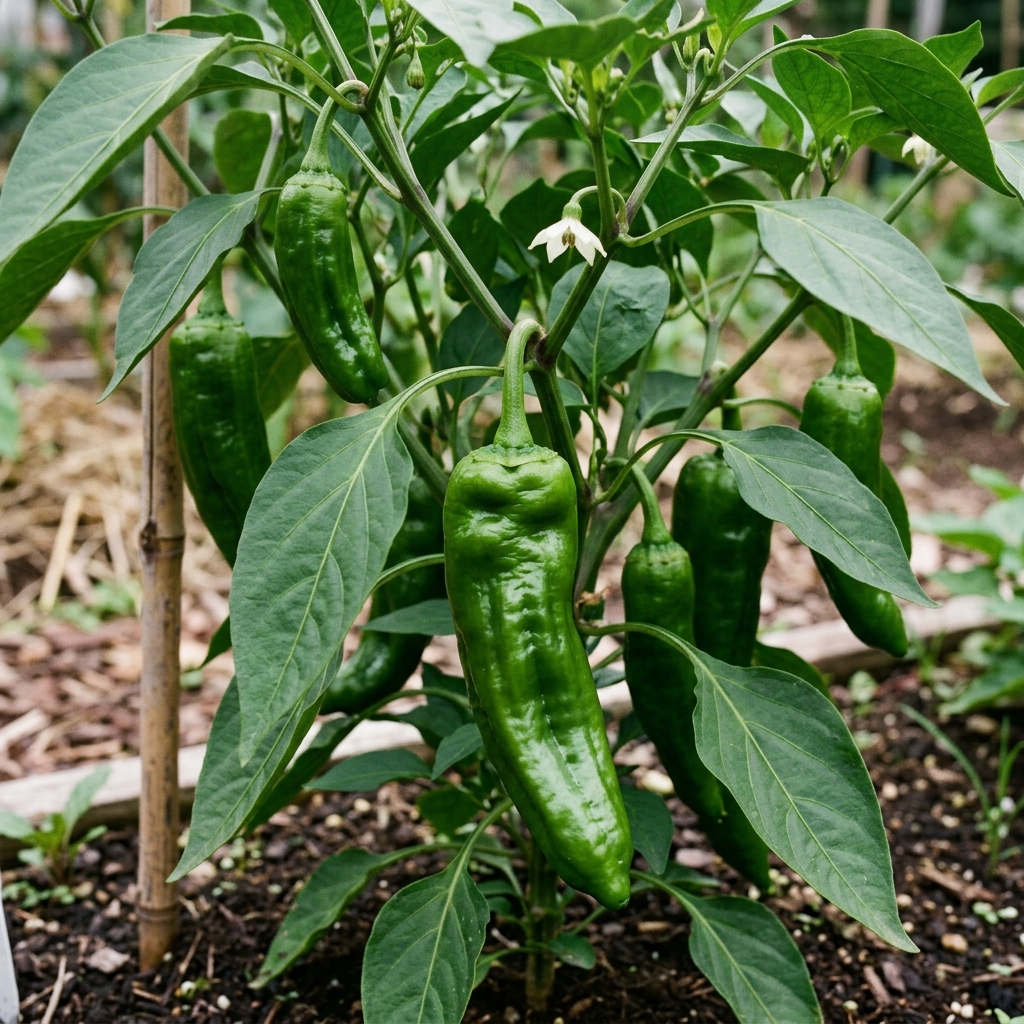
The plant exhibits an upright bushy growth habit with green foliage and solitary white flowers typical of Capsicum annuum. Its pendant fruits are large, elongated, and slightly curved, featuring gentle longitudinal ridges, a wrinkled and creased skin surface, and a distinctive indentation at the shoulder.
Pods transition from green and dark green when immature to bright red at full physiological maturity. Unlike thinner-walled Japanese chilis, Manganji peppers develop thick pod walls while retaining a remarkably soft, edible skin. Internally, the seed cavity is largely hollow, with a low count of straw-colored seeds clustered tightly near the top calyx rather than dispersing throughout the fruit chamber.
Manganji is easily distinguished from other Japanese cultivars: it is substantially larger and thicker-fleshed than the common Shishito, and possesses a noticeably wider diameter and fleshier texture than its ancestral parent, Fushimi togarashi.
Heat Profile
Manganji pepper is classified as a sweet, non-pungent pepper with an absolute rating of 0 SHU. Due to negligible or completely absent capsaicin content, it delivers no chemical heat, making it accessible for direct consumption and diverse culinary preparations without residual spiciness.
Flavor and Aroma
The sensory profile of Manganji pepper centers on sweet, fresh, and mild vegetal notes. The thick pericarp provides a crisp, juicy texture that sweetens further when cooked, while the aroma remains clean and reminiscent of fresh sweet bell pepper without any pungent sharpness.
Cultivation
Manganji pepper thrives in a temperate climate with full sun exposure and fertile, well-drained soil. Because of its vigorous fruiting habit and high market value, it is widely cultivated in both open fields and protected greenhouse environments. Being an open-pollinated variety, true-to-type seeds can be saved from isolated mature fruits.
Culinary Applications
In Japanese gastronomy, Manganji is celebrated for retaining its structure and moisture under high heat. Because the seeds are sparse and located at the stem base, pods are frequently cooked whole without coring.
- Grilling and Roasting: Charred whole over open flames or roasted until blistered, often dressed with soy sauce, bonito flakes, or ginger.
- Tempura and Pan-Frying: Lightly battered and fried crisp as tempura, or pan-seared in oil to highlight its tender skin.
- Simmering and Tsukudani: Simmered in dashi broth or preserved through slow simmering in sweet soy sauce to create traditional tsukudani.
- Stuffing and Pickling: Its thick walls and hollow interior make it well-suited for stuffing with meat or seafood mixtures, as well as light pickling.



Leave A Comment