
Peperoncino Calabrese
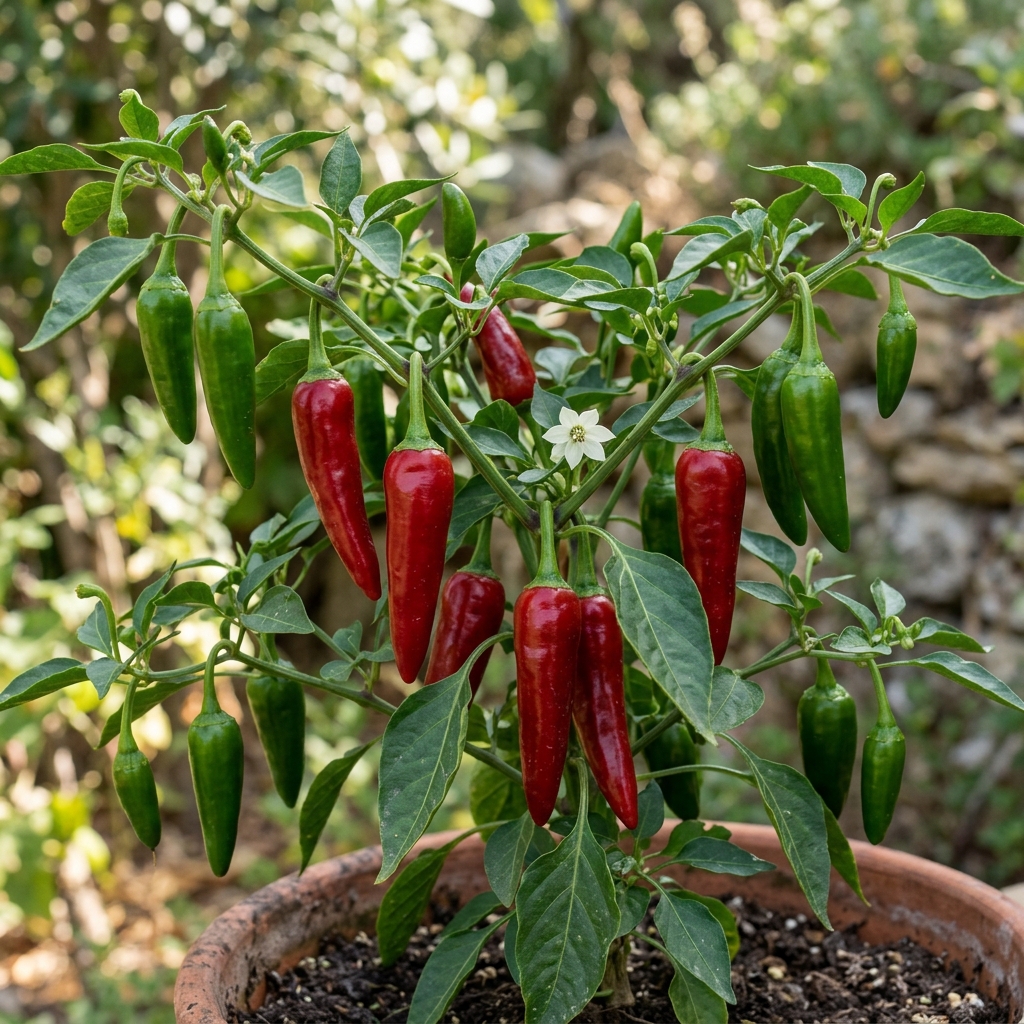
Peperoncino Calabrese encompasses traditional landraces and cultivars of Capsicum annuum native to the Calabria region of southern Italy. Functioning both as a broader regional designation and a specific cultivar group, these peppers develop on bushy plants with green foliage and white flowers, bearing conical to horn-shaped pods that mature from green to deep red.
Renowned for its medium-hot profile, the pepper provides a direct, lingering warmth focused across the tongue and throat rather than overwhelming sharpness. Its balanced combination of fruitiness, earthiness, and mild natural smokiness makes it a foundational culinary staple of southern Italy, underpinning regional classics such as ‘Nduja di Spilinga and Olio Santo.
Origin and Genetics
Peperoncino Calabrese represents an enduring agricultural tradition in Calabria, Italy. The name functions as an umbrella classification for several regional landraces as well as specific selections stabilized under the cultivar name ‘Calabrese’. Within the region, pod variations range from small, rounded cherry forms to elongated horn shapes often identified locally under names such as Diavolicchio or Sigaretta.
Botanical Profile
The plant exhibits a compact, bushy growth habit characterized by dense green foliage and solitary white flowers typical of Capsicum annuum. Its fruits are primarily conical to horn-shaped, featuring smooth to slightly wrinkled surfaces. Throughout development, the pods undergo a clear transition from an immature vibrant green to a saturated deep red at full maturity.
Heat Profile
The pungency of Peperoncino Calabrese is categorized as medium-hot. Rather than delivering an instant or sharp spike, the capsaicin profile produces a direct, warming sensation that lingers steadily across the tongue and throat, offering sustained warmth without masking companion flavors.
Flavor and Aroma
Beyond heat, the pepper is celebrated for a complex organoleptic profile. The flesh combines sweet and fruity top notes with a grounded, earthy undertone and a natural, subtle smokiness. The aroma is distinctly pungent and peppery, carrying fruity accents that become particularly pronounced when crushed or heated.
Cultivation
Adapted to the warm, sunny conditions of southern Italy, Peperoncino Calabrese thrives in a Mediterranean climate requiring full sun exposure and well-drained soil. The plants offer moderate ornamental value in garden beds and vegetable plots due to the visual contrast between the lush canopy and the ripening red horn-shaped pods.
Culinary Applications
Peperoncino Calabrese is integral to regional Italian preservation and cooking methods. It is the signature spicing agent in authentic ‘Nduja di Spilinga and other cured meats, and it is widely infused into olive oil to create Olio Santo. The pods are equally suited for drying into crushed red pepper flakes, pickling in oil, fermenting, and simmering into rich pasta sauces.



Leave A Comment