
Brazilian Starfish Pepper
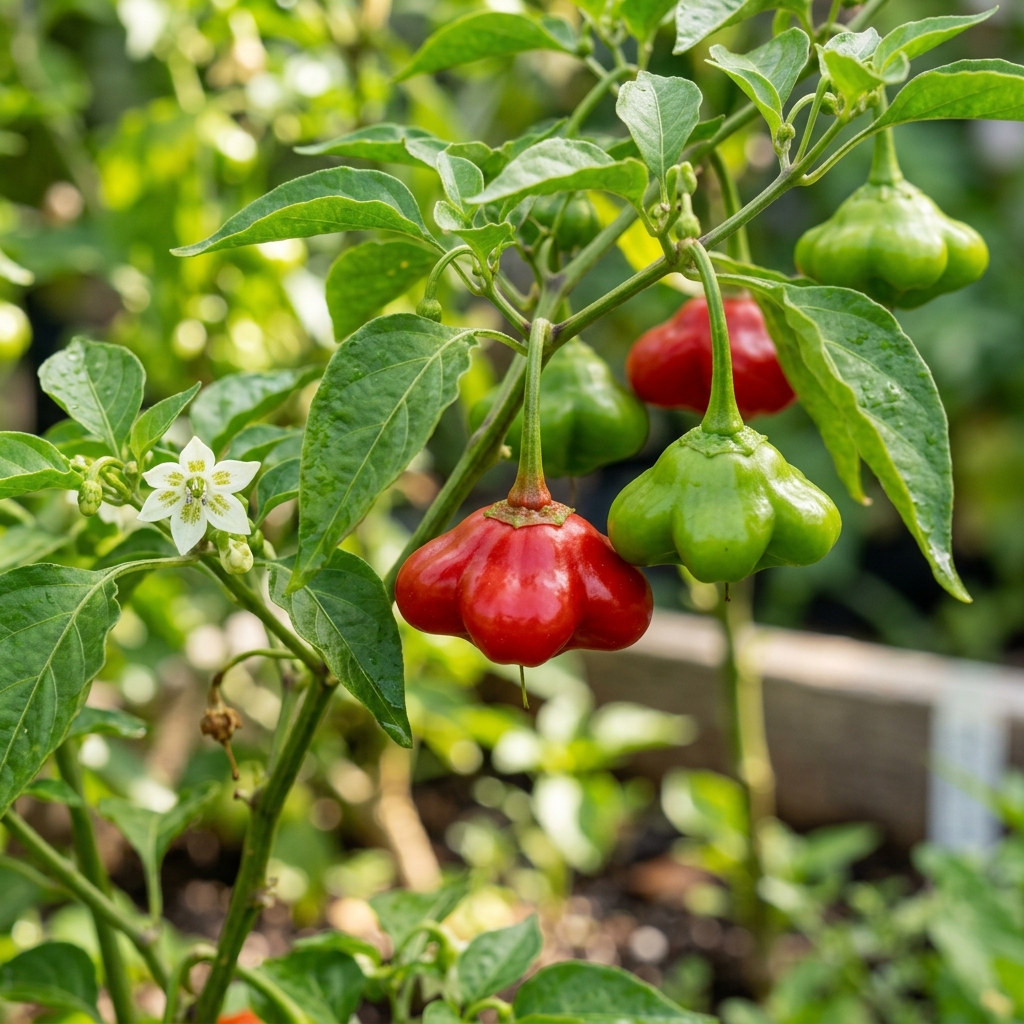
The Brazilian Starfish Pepper is an open-pollinated cultivar of Capsicum baccatum originating from Brazil. Readily identified by its flattened, disc-like fruit with pronounced lobed margins resembling a starfish, the variety transitions from green to bright red upon maturity. It delivers a moderate heat level ranging from 5,000 to 30,000 Scoville Heat Units, making it a flavorful yet approachable specialty chili.
What distinctly sets this pepper apart is the uneven distribution of its pungency. The thick, crisp outer perimeter of the fruit is naturally sweet with apple-like and floral undertones, while the heat is concentrated tightly within the inner placental tissue and seeds. Combined with an attractive, sprawling architecture and white blossoms bearing greenish-yellow corolla spots, the plant offers both high ornamental and culinary value.
Origin and Genetics
The Brazilian Starfish pepper, known locally in some regions as Pimenta Estrela, originates from Brazil. It belongs to the Capsicum baccatum species, a group recognized for its distinct floral morphology and South American ancestry. As a stable, open-pollinated cultivar, it breeds true from seed across successive generations.
Botanical Profile
The plant exhibits a vigorous, tall, and sprawling indeterminate growth habit with vibrant green foliage. Its flowers display the classic botanical signature of the species, bearing white petals marked with greenish-yellow corolla spots at the base of the lobes. Seeds are typically straw to tan in color.
The fruit develops in a pendant orientation and forms a flattened, star-shaped disc with smooth to slightly ribbed surfaces and five to eight lobed margins. The pods have medium-thick walls and undergo a dramatic color transition, shifting from an initial green to a brilliant, uniform red when fully ripe.
Heat Profile
Yielding a measured heat range of 5,000 to 30,000 SHU, the Brazilian Starfish is classified as a medium-heat pepper. Its pungency is characterized as crisp and clean, but it is not uniformly distributed throughout the pod. The vast majority of the capsaicin is localized in the central placental tissue and seeds, leaving the outer lobed pericarps exceptionally mild.
Flavor and Aroma
Beyond its visual appeal, the Brazilian Starfish is celebrated for its complex, refreshing flavor profile. The thick outer lobes are notably sweet and juicy, offering distinct apple-like and fruity notes complemented by subtle floral nuances. The crushed or sliced pods release a fresh, fruity aroma that enhances both raw and cooked culinary preparations.
Cultivation
This variety thrives under full sun and requires warm climatic conditions paired with well-draining soil. Due to its vigorous and spreading branching structure, individual plants benefit from ample spacing or physical support. The cultivar is well suited for standard garden beds, greenhouse cultivation, and large containers.
Culinary Applications
The unique shape and localized heat make the Brazilian Starfish versatile in the kitchen. Its sweet, crunchy outer lobes make it an exceptional candidate for fresh eating, salads, and salsas, particularly when the hot inner core is removed to keep heat levels low. For long-term preservation, the medium-walled pods respond well to pickling, dehydrating, and freezing, and the dried pods can be ground into a sweet, mildly spicy finishing powder.



Leave A Comment