
Naga Viper Pepper
The Naga Viper pepper is an ultra-potent Capsicum chinense cultivar bred by Gerald Fowler of The Chilli Pepper Company in Cark, Cumbria, England. Introduced in 2011, this intense three-way hybrid briefly held the Guinness World Record for the world’s hottest chili after testing by Warwick HRI at the University of Warwick documented an average pungency rating of 1,382,118 Scoville Heat Units (SHU).
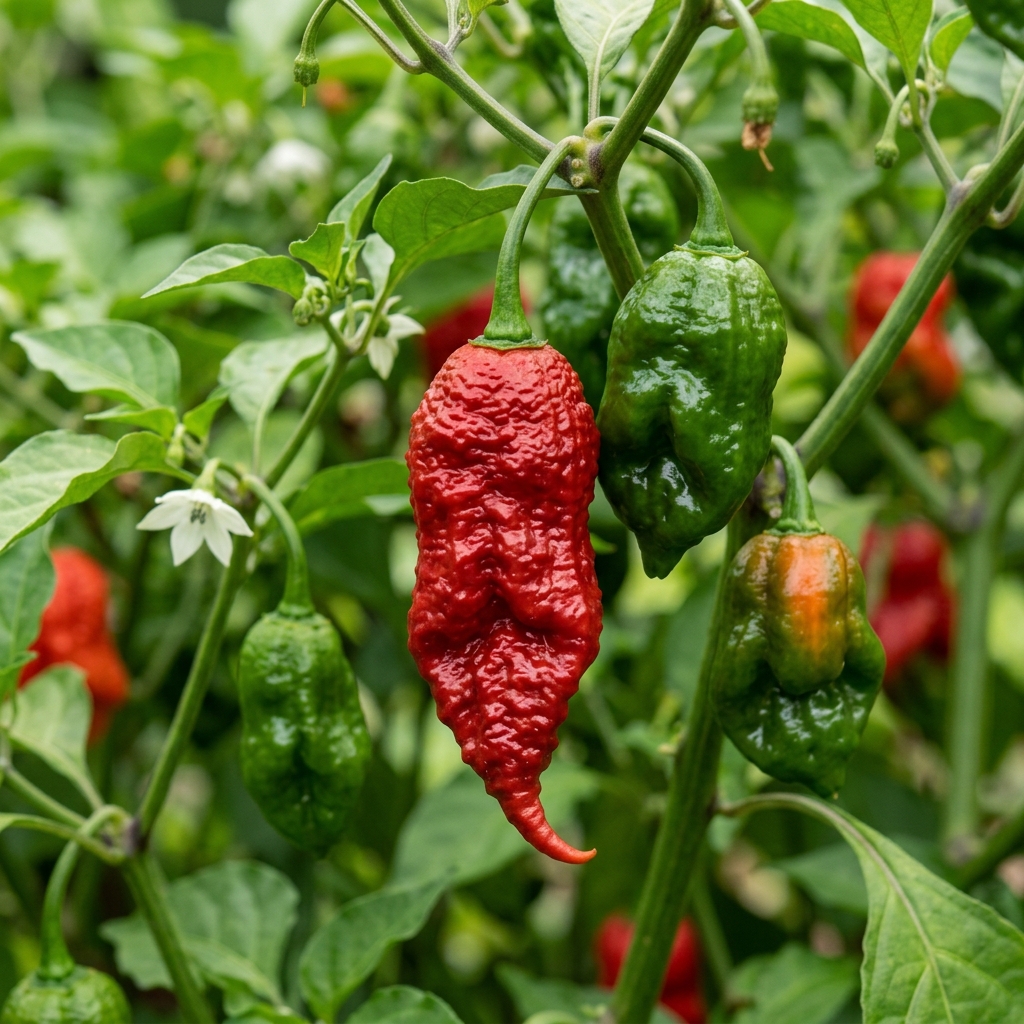
Created through a complex cross of three renowned landraces—the Naga Morich, Bhut Jolokia, and Trinidad Scorpion—the Naga Viper produces irregular, deeply wrinkled pods that ripen from green to bright red. Because of its multi-parent pedigree, early generations showed notable morphological variation while consistently delivering a lingering, severe burn localized in the throat and back of the mouth.
Origin and Genetics
The Naga Viper was developed in Cark, Cumbria, England, by breeder Gerald Fowler at The Chilli Pepper Company. Released in 2011, the cultivar was engineered as a complex tri-hybrid combining the genetics of three established superhot varieties: the Naga Morich, the Bhut Jolokia, and the Trinidad Scorpion.
Due to its multi-way hybrid ancestry, the Naga Viper was considered an unstable hybrid at the time of its commercial introduction. Early generations did not breed completely true from saved seed, resulting in natural phenotype variations among cultivated plants.
Botanical Profile
The plant grows as an upright bushy subshrub featuring standard green foliage and small white to off-white blossoms. Its fruits mature along a clear color transition, shifting from an immature bright green to a deep red at full maturity.
Pods display a pendant growth habit with an irregular, conical shape, frequently terminating in a pointed or tapered tip. The pod exterior is characterized by an uneven, wrinkled and bumpy surface typical of inter-varietal superhot crosses.
Heat Profile
Classified firmly in the superhot category, the Naga Viper registered an official average rating of 1,382,118 SHU during laboratory analysis conducted by Warwick HRI at the University of Warwick. This testing led to its formal certification by Guinness World Records as the world’s hottest chili in February 2011, a title it held prior to the emergence of later cultivars such as the Trinidad Moruga Scorpion.
The heat delivery is marked by an intense, lingering pungency that concentrates primarily across the throat and back of the mouth, a burn pattern characteristic of its ancestral landrace lineage.
Flavor and Aroma
Before the extreme pungency dominates the palate, the Naga Viper presents distinct fruity, sweet, and floral flavor notes. The aroma of freshly cut pods is pungent and fruity, reflecting the high concentration of capsaicinoids and essential volatile compounds within the fruit tissue.
Cultivation
Cultivating the Naga Viper requires standard conditions suited for superhot Capsicum chinense varieties, including full sun exposure, well-drained soil, and warm growing temperatures. Because early lines represent a complex, non-open-pollinated hybrid, seed saving requires careful selection to maintain characteristic pod morphology and heat levels.
Culinary Applications
Owing to its extraordinary heat concentration, the Naga Viper is predominantly utilized in the commercial manufacture of specialty hot sauces, high-heat food challenges, and dehydrated seasoning blends such as crushed flakes and powders. Common preservation methods include hot-air drying, freezing, and mash fermentation for long-term sauce stability.



Leave A Comment