
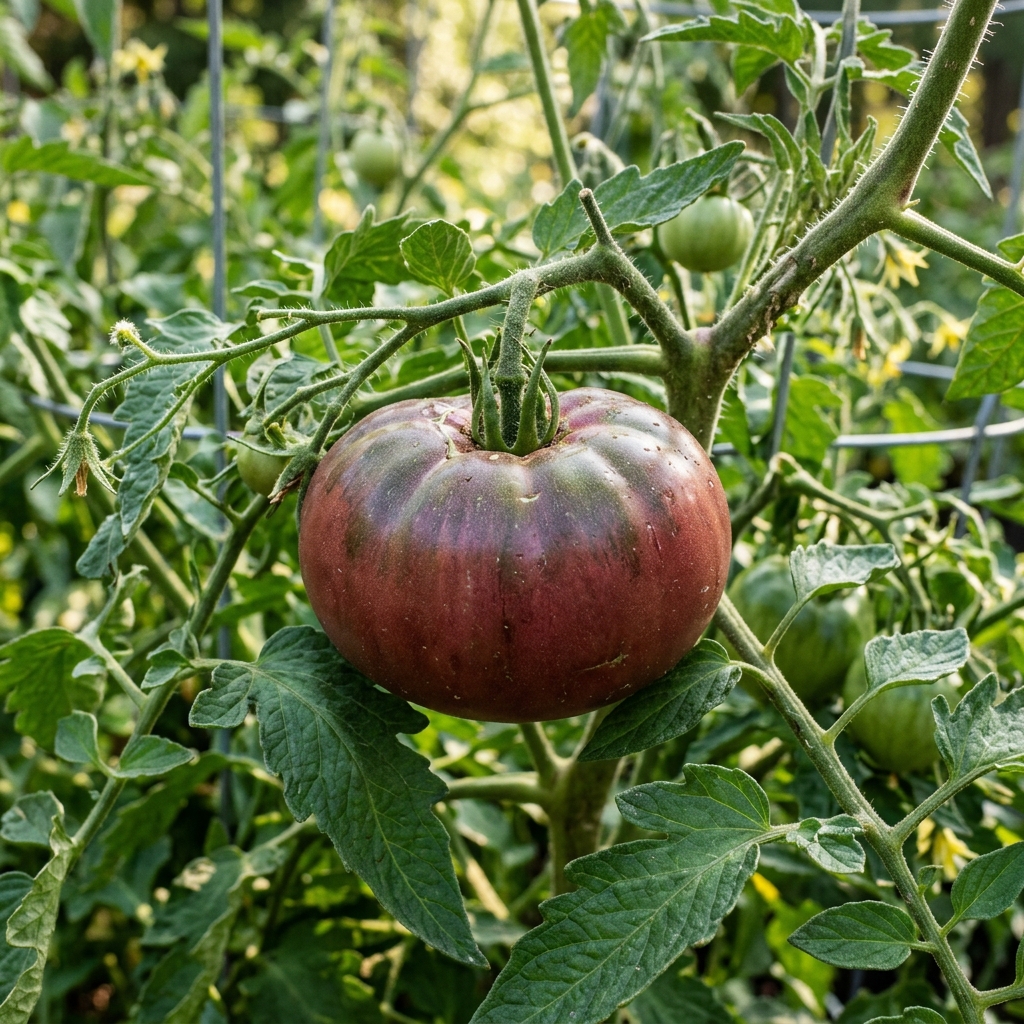
Cherokee Purple
Cherokee Purple is an open-pollinated heirloom tomato cultivar belonging to the species Solanum lycopersicum. Originating from seeds preserved by the Cherokee people of Tennessee, the variety entered widespread cultivation after gardener John Green shared seed stock with tomato collector Craig LeHoullier in 1990, followed by its commercial introduction through Southern Exposure Seed Exchange in 1993.
Distinguished by its vigorous indeterminate growth habit and regular-leaf foliage, the cultivar yields large, oblate beefsteak fruit characterized by a dusky purplish-pink to brownish-red exterior with persistent green shoulders. Renowned for its dense, juicy reddish-purple interior, Cherokee Purple delivers a celebrated flavor profile defined by rich, sweet, and smoky undertones with well-balanced acidity.
Origin and Genetics
The lineage of Cherokee Purple traces to heirloom seed preserved within the Cherokee Nation in Tennessee. In 1990, John Green of Sevierville, Tennessee, sent seeds of this unnamed family heirloom to tomato expert Craig LeHoullier, who named the cultivar and introduced it to the wider gardening community. It gained formal commercial distribution through Southern Exposure Seed Exchange in 1993.
As a genetically stable, open-pollinated heirloom, Cherokee Purple breeds true from saved seed when isolated from cross-pollination. The cultivar has also given rise to spontaneous stabilized mutations, including the potato-leaf variants Cherokee Chocolate and Cherokee Green.
Botanical Profile
Cherokee Purple develops as an indeterminate vine bearing standard green, regular-leaf foliage and small yellow blossoms. Its fruit belongs to the large beefsteak classification, exhibiting an oblate shape with smooth skin and mild ribbing across the upper shoulders.
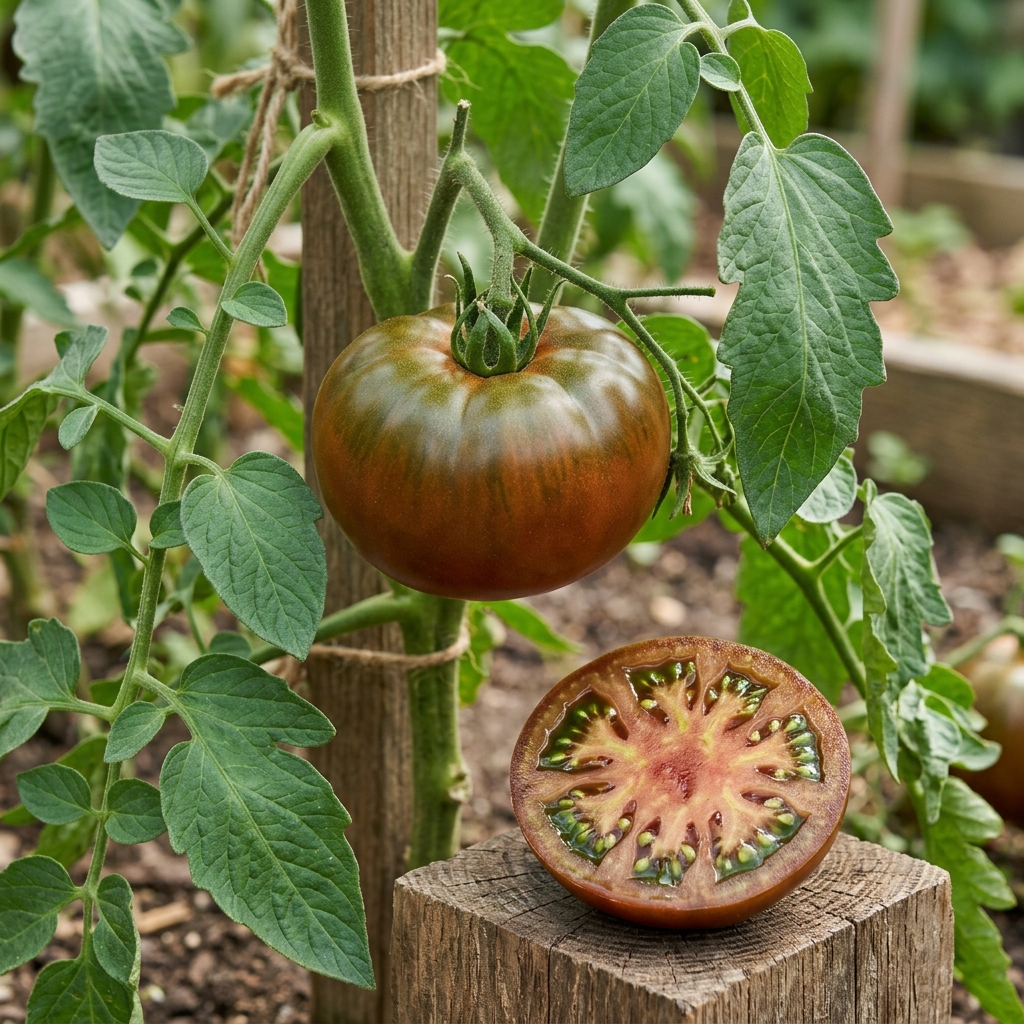
The fruit displays a distinctive color progression, maturing from solid green into a dusky blend of deep purplish-pink, brownish-red, and persistent green shoulders. Internally, the flesh is deep reddish-purple, multi-locular, dense, and juicy, encased in a relatively thin skin with moderate resistance to cracking.
Growth and Performance
Cherokee Purple is well-suited for open-field cultivation, demonstrating moderate tolerance to both heat and humidity. The vigorous vines produce a moderate yield of large beefsteak tomatoes over an extended harvest window. Due to its indeterminate habit and substantial fruit size, structural support via trellising or heavy-duty staking is necessary to keep vines and fruit elevated.
Flavor and Aroma
The sensory profile of Cherokee Purple is widely regarded as one of the benchmarks for dark heirloom tomatoes. It offers a complex blend of sweetness and acidity complemented by distinct smoky and savory undertones. Its aroma is deeply fruity and earthy, pairing with the dense, tender flesh to provide a full-bodied texture upon consumption.
Cultivation
Optimal growth requires full sun exposure and fertile, well-drained soil. Because the thin skin can be susceptible to environmental stresses, consistent moisture and robust support systems are recommended. Gardeners practicing seed saving should maintain spatial isolation from other flowering tomato cultivars to prevent unwanted cross-pollination and maintain line purity.
Culinary Applications
Cherokee Purple is primarily utilized as a premium fresh slicing tomato. Its dense, juicy beefsteak texture and balanced sweetness make it ideal for raw preparations, including layered salads, artisan sandwiches, and fresh garnishes. It is not typically recommended for paste or canning sauces due to its high moisture content and specific culinary suitability for fresh eating.



Leave A Comment