

White Widow
White Widow is a classic balanced hybrid cultivar originally developed in Amsterdam during the mid-1990s. Credited primarily to Green House Seed Company and breeder Shantibaba, the cultivar achieved international recognition after winning the High Times Cannabis Cup in 1995. Bred from a cross between a Brazilian sativa landrace and a resinous South Indian indica hybrid, it served as the foundational parent for the renowned ‘White’ family of cannabis cultivars.
Known for its heavy coating of milky-white resin glands, White Widow typically exhibits an equal 50% indica and 50% sativa genetic distribution. Its chemical profile features moderate to high potency alongside a distinct terpene ensemble dominated by myrcene, beta-caryophyllene, and alpha-pinene. Plants develop sturdy, medium-height structures that adapt well to various growing methods, finishing with dense, conical colas over an eight- to nine-week flowering period.
Origin and Genetics
White Widow was introduced to the Amsterdam cannabis scene in 1994 by Green House Seed Company under breeders Shantibaba and Arjan Roskam. The cultivar’s genetic architecture combines a Brazilian Sativa landrace with an elite South Indian Indica hybrid, yielding an evenly balanced 50% indica and 50% sativa profile. Following its debut, it secured top honors at the 1995 High Times Cannabis Cup and established itself as one of the most prolific breeding blocks in contemporary cannabis development.
Cannabinoid and Terpene Profile
Laboratory testing and breeder documentation report a total THC range generally spanning 15% to 25% THC, with typical concentrations centering around 18.5%. Green House Seed Co. specifically documents baseline cannabinoid levels of 18% to 20% THC and CBD content between 0.1% and 0.3%.
The cultivar’s aromatic and functional profile is shaped by a dominant presence of myrcene, beta-caryophyllene, and alpha-pinene. Secondary analytical terpene returns also identify detectable concentrations of humulene, terpinolene, and limonene.
Aroma and Flavor
White Widow is characterized by a pungent, classic terpene bouquet dominated by earthy and fresh pine top notes. Accompanying tones include deep woody accents, crushed herbs, and a subtle peppery spice on the exhale.
Reported Effects
Consumer observations describe White Widow as producing a rapid onset that delivers initial cerebral stimulation, euphoria, and mental clarity. As the experience progresses over its sustained 2 to 3 hour duration, the active head effects gently transition into a relaxed physical state without causing heavy sedation at moderate intake levels. Reported experiential descriptors include feeling uplifted, energetic, creative, and relaxed.
Reported Therapeutic Uses
In community reports and cannabis database surveys, consumers frequently document turning to White Widow for stress, pain, depression, fatigue, and insomnia. However, these source- and community-reported uses are experiential observations and do not establish that the cultivar treats, cures, or prevents any medical condition or clinical pathology.
Cultivation Characteristics
White Widow is rated as moderately difficult to cultivate, demonstrating strong adaptability across indoor, outdoor, and greenhouse environments in temperate, continental, and Mediterranean climates. The plant exhibits a sturdy branch framework with moderate internodal spacing and an estimated transition stretch of 100% to 150%.
Indoor flowering cycles complete within 56 to 63 days (approximately 8.5 weeks), with potential indoor yields reaching up to 800 g/m² under optimal conditions. In outdoor settings, plants finish between late September and early October in the Northern Hemisphere, generating yields up to 900 g per plant. The cultivar responds favorably to Sea of Green (SOG) and Screen of Green (SCROG) training techniques and possesses natural resilience against common mold, mildew, and pest pressures.
Appearance and Phenotypes
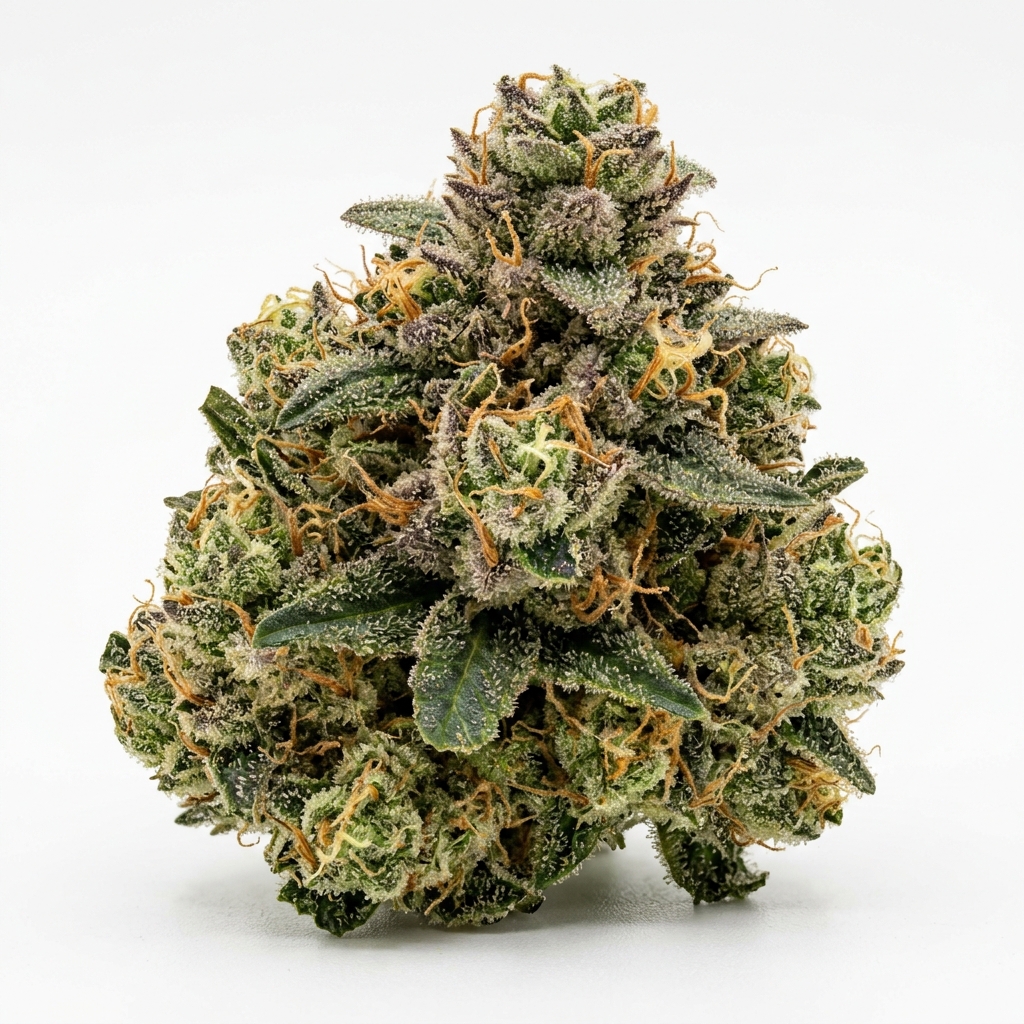
The mature flower is dense, forming conical to rounded clusters of thick calyxes. Buds display a blended palette of pale green and olive green, woven with brownish-orange to bright orange pistils. The cultivar owes its name to a notably heavy blanket of glandular trichomes that coats the calyxes and surrounding dark forest-green sugar leaves in a frosted white layer. While standard seed lines remain largely uniform, minor phenotype variations may exhibit slightly different stretch rates or lean either toward higher sativa resin production or indica calyx density.
Identity and Evidence Notes
Historical accounts regarding White Widow’s exact genesis contain competing claims; while Green House Seed Co. and Shantibaba are widely credited with its commercial stabilization, Dutch grower Ingemar (De Sjamaan) has also historically claimed to have originated the underlying genetics. Following Shantibaba’s departure from Green House to co-found Mr. Nice Seedbank, the original parental breeding stock was preserved and offered under the name Black Widow. While baseline catalogs define the cultivar as an equal 50/50 hybrid, some secondary seed banks distribute selections ranging between 60% sativa and 60% indica.



Leave A Comment